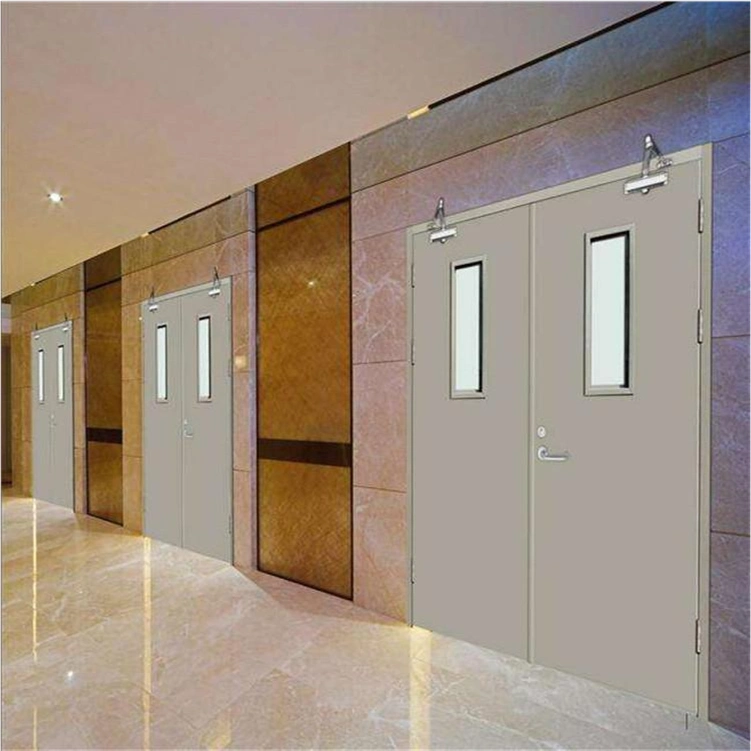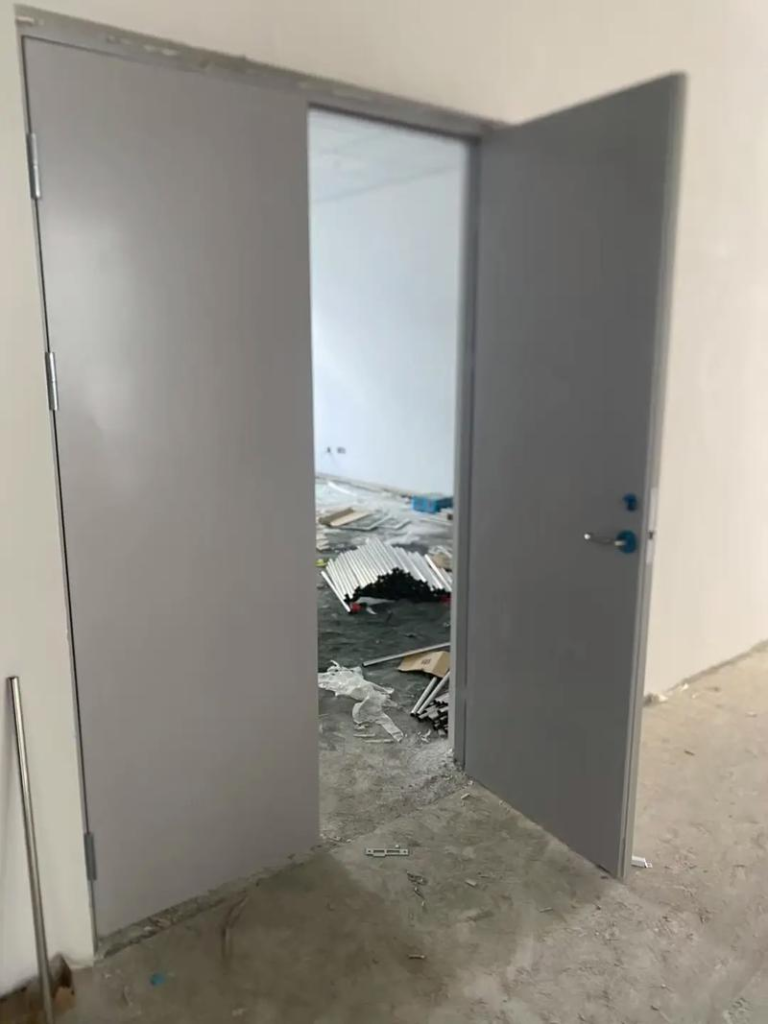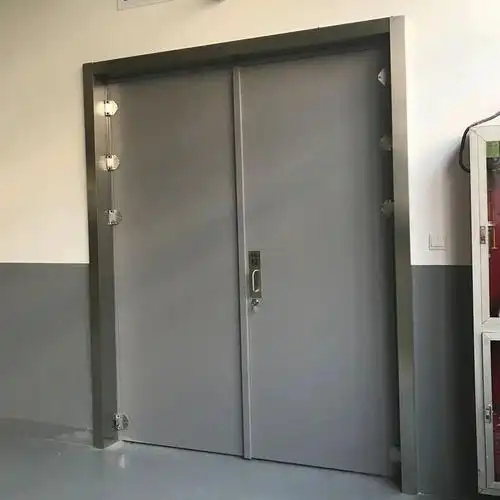
Blast resistant doors (Blast Resistant Door / Explosion Proof Door) and fire doors (Fire Door) are often combined or functionally overlapped in chemical plants, oil depots, refineries, and other flammable/explosive environments. However, their core protection objectives are fundamentally different: blast resistant doors focus on “blast resistance and impact protection,” withstanding explosion shock waves and fragments; fire doors focus on “fire blocking and smoke containment,” preventing the spread of flame and high-temperature smoke through fire integrity and insulation. The two types of doors differ essentially in design standard systems, test methods, and certification logic.
1. Core Concepts and Functional Distinction
| Comparison Item | Fire Door | Blast Resistant Door |
|---|---|---|
| Core Function | Fire blocking, smoke containment, thermal insulation | Blast resistance, impact protection, withstands explosion shock waves |
| Failure Mode | Excessive temperature rise on unexposed face, flame penetration | Excessive door deformation, hinge detachment, fragment scattering |
| Major Standards | EN 1634-1, UL 10C, BS 476-22, NFPA 80 | ASTM F2247, API RP 752/753, GJB 2805B |
| Test Environment | Standard fire resistance test furnace (temperature-rise curve) | Explosion shock tube / blast tube or equivalent static load |
| Performance Indicators | E (Integrity), I (Insulation), W (Radiation) | Peak overpressure (psi/kPa), duration (ms), impulse (psi·ms) |
| Typical Applications | Fire compartments, evacuation passages, equipment rooms | Control rooms, electrical rooms, substations, hazardous chemical warehouses |
In petrochemical plant areas, doors in personnel-concentrated locations such as control rooms often require dual fire + blast resistant performance, necessitating “blast-fire composite door” design, passing two independent test regimes and obtaining dual certification.
2. Special Fire Door Design and International Standard Systems
2.1 European System: Evolution from BS 476 to EN 16034
EN 1634-1 (Fire resistance and smoke control tests for door and shutter assemblies) is currently the most widely accepted fire door fire resistance test standard for European, Middle Eastern, and Southeast Asian projects. Its predecessor, BS 476-22, is a British traditional standard; the two differ in test principles: BS 476 is based on British historical fire test methods, while EN 1634-1 employs the EU unified temperature-rise curve and pressure environment. The same product typically requires separate testing and cannot be directly interchanged.
EN 16034:2014 is a harmonised standard under the EU Construction Products Regulation (CPR, EU 305/2011). Since November 1, 2019, CE marking has been mandatory for external fire doors. This standard integrates fire performance and smoke control into a product standard, marking Europe’s shift from “component testing” to “whole door system certification.”
| Standard | Nature | Rationale and Historical Background |
|---|---|---|
| BS 476-22 | British national standard | Developed in the mid-20th century by the UK Fire Research Station (FRS), based on Commonwealth building traditions, emphasizing integrity testing. Gradually replaced by the EN system but still used in parallel |
| EN 1634-1 | European test method standard | A product of the 1990s EU single market, harmonizing national differences, establishing unified fire resistance test methods for doors and shutters, providing the test basis for EN 16034 |
| EN 16034 | European product harmonised standard | Published in 2014, mandatory CE marking from 2019, integrating fire resistance (E/EI/EW) and smoke control (Sa/S200), requiring consistency of the whole door system (including hardware, seals, glazing) |
2.2 U.S. System: UL 10C and NFPA 80 Label Culture
UL 10C (Positive Pressure Fire Test) is a positive-pressure fire door test standard developed by Underwriters Laboratories. Compared to the older UL 10B (neutral pressure), it better simulates the smoke pressure environment in real fires. Doors passing UL 10C must bear a permanent metal label riveted at the hinge edge by the manufacturer, indicating the testing laboratory, manufacturer, fire rating (20 min–3 h), and test standard.
NFPA 80 (Standard for Fire Doors and Other Opening Protectives) is an installation and maintenance standard developed by the National Fire Protection Association. Its core contribution is establishing the “fire door assembly” concept — the door leaf, frame, hardware, glazing, and seals must be certified as an integrated system; any single component replacement may compromise compliance. Saudi Arabia and other Middle Eastern countries directly reference NFPA 80 as the basis for fire door labeling requirements.
2.3 Special Fire Door Design for Flammable/Explosive Environments
| Special Design | Technical Points | Standard Basis |
|---|---|---|
| Smoke Control (Sa/S200) | Limits smoke leakage; Sa = ambient leakage, S200 = leakage at 200 °C | EN 16034, EN 1634-3 |
| Self-Closing Reliability (Class C) | 5,000–10,000 cycle testing; fire release device reliably closes | EN 16034, EN 1191 |
| Spark-Free Hardware | Locks, hinges, handles in stainless steel or copper alloy to prevent spark generation on impact | Project specification / ATEX zone requirements |
| Explosion-Proof Motor/Operator | Electric doors with Explosion Proof Operator, meeting Class I Div 2 / Zone 2 | NEC / IEC 60079 |
| Anti-Static Grounding | Door leaf and frame must be reliably grounded to prevent static accumulation igniting flammable gases | GB 50160 / Project HSE requirements |
In petrochemical plant areas, fire doors are often located within explosion hazard zones (Zone 1/Zone 2). Therefore, their drive motors, electromagnetic locks, door closers, and other electrical components must additionally meet ATEX 2014/34/EU or IECEx explosion protection certification requirements — a dimension not involved in ordinary building fire doors.
3. Special Blast Resistant Door Design and International Standard Systems
3.1 U.S. System: ASTM F2247 and API RP 752/753
ASTM F2247 (Standard Specification for Blast Resistant Door and Frame Assemblies) is developed by ASTM International. It classifies blast resistant doors into Classes I, II, and III, which must be verified through independent third-party engineering analysis or prototype explosion/shock tube testing. The standard permits customized design based on peak overpressure (0.5–50.0 psi), duration (ms), impulse (psi·ms), and rebound response (0%/50%/100%).
API RP 752 (Management of Hazards Associated with Location of Process Plant Permanent Buildings) and API RP 753 are recommended practices by the American Petroleum Institute for permanent buildings in process plant areas. API RP 752 originated from lessons learned in major accidents such as the 2005 BP Texas City refinery explosion. Its core requirement is that personnel-concentrated buildings such as control rooms and electrical rooms located within process plant areas must be designed for blast resistance based on the overpressure consequences of potential vapor cloud explosions (VCE), typically requiring resistance to 3–10 psi (20.7–69.0 kPa) overpressure. As the weak point in the building envelope, blast resistant doors must match the blast rating of the building structure.
3.2 Chinese Military System: GJB 2805B-2021
GJB 2805B-2021 is the latest Chinese military standard for blast resistant airtight doors, requiring door assemblies to withstand high-intensity blast pressure tests while ensuring the integrity of the sealing structure is not compromised. Doors under this standard employ multi-layer steel plate sandwich construction with high-strength flame-retardant sealing materials, featuring both ventilation and airtight switching functions, widely used in armories, ammunition depots, and high-grade protective facilities. Some high-end civilian petrochemical projects also reference this standard.
3.3 Special Blast Resistant Door Design for Chemical Plants / Oil Depots
| Special Design | Technical Points | Purpose |
|---|---|---|
| Thickened Steel Plates | Door leaf panels 3–6 mm, frames 4–8 mm, far exceeding ordinary fire doors | Resist peak pressure of explosion shock waves |
| Reinforced Frame | Welded box-section frame with internal stiffener plates | Prevent overall frame deformation or pull-out |
| Blast Resistant Hinges | Heavy-duty concealed hinges with load capacity 5–10× that of ordinary hinges | Avoid door leaf detachment becoming fragments during explosion |
| Self-Closing Buffer Mechanism | Automatically closes and seals after explosion, blocking secondary blast wave propagation | Prevent flame propagation through openings |
| Intumescent Seals | Expand at high temperature to seal, providing both fire resistance and blast airtightness | Dual function: fire blocking + airtight sealing |
| Distinction Between Explosion Venting and Blast Resistance | Explosion venting doors (Explosion Venting) actively rupture to release pressure when overpressurized; blast resistant doors must remain intact | Opposite functions; must not be confused |
In refineries and chemical plants, doors between control rooms and process areas typically require dual ASTM F2247 + UL 10C certification — the same door assembly must pass both explosion shock testing and positive-pressure fire resistance testing, with manufacturing costs far exceeding single-function doors.
4. Overlapping Design Requirements for Flammable/Explosive Environments
4.1 ATEX / IECEx Zone Requirements for Door Electrical Components
Chemical plants and oil depots have explosive gas atmospheres. If doors are equipped with electric operators, electromagnetic locks, door magnetic switches, or other electrical components, the explosion protection type must be selected according to the zone classification:
| Zone Classification | ATEX Equipment Category | IECEx EPL | Applicable Protection Type | Typical Door Components |
|---|---|---|---|---|
| Zone 0 | Category 1 | Ga | Ex ia (Intrinsic Safety) | Sensors (rarely used on doors) |
| Zone 1 | Category 2 | Gb | Ex d (Flameproof), Ex e (Increased Safety) | Electric door closers, electromagnetic locks |
| Zone 2 | Category 3 | Gc | Ex n (Non-sparking) | Ordinary motors certified for use |
ATEX originated from EU Directive 1994/9/EC (later updated to 2014/34/EU) and is mandatory European legislation. IECEx originated from the International Electrotechnical Commission (IEC) 60079 series standards and is a voluntary international certification system, but widely accepted in the Middle East, Australia, and Southeast Asia. The two are not interchangeable; ATEX is mandatory for EU market entry, while dual certification is recommended for global market access.
4.2 Anti-Static and Spark-Free Design
| Requirement | Specific Measures | Standard Source |
|---|---|---|
| Spark-Free Floor/Threshold | Blast door thresholds use non-sparking asphalt concrete or copper alloy edging | GB 50160-2018 Sec. 5.7.4 |
| Door Body Grounding | Soft copper braid bonding between door leaf and frame, grounding resistance ≤ 4 Ω | GB 50057 / Project electrical specification |
| Spark-Free Hardware | Lock bolts, hinge pins in stainless steel 316L or beryllium copper alloy | Project specification / NFPA 80 |
| Anti-Static Coating | Door surface coated with conductive epoxy coating, surface resistance 10⁶–10⁹ Ω | Project HSE specification |
5. Rationale Analysis of Major International Standards
5.1 European Standards: Product of a Unified Market
- BS 476: Born in the mid-20th century at the UK Fire Research Station (FRS), based on British masonry building traditions and extensive real-fire test experience, emphasizing “integrity priority.” Because the UK was the suzerain of the Middle East, Hong Kong, Singapore, and other regions, BS 476 remains deeply influential in these areas.
- EN 1634-1 / EN 16034: Products of the 1990s EU single market. Previously, national standards (German DIN, French NF, British BS) were mutually unrecognized, creating trade barriers. Through over 20 years of harmonization by CEN (European Committee for Standardization), EN 16034 was finally published in 2014, with mandatory CE marking under the CPR regulation, achieving “one test, valid throughout Europe” for fire door products.
5.2 U.S. Standards: Insurance-Driven Label System
- UL 10C: Originated from Underwriters Laboratories’ analysis of fire insurance claims data. Traditional neutral-pressure testing (UL 10B) could not reflect real-fire conditions where positive pressure forces smoke through door gaps, so UL developed positive-pressure testing in the 1990s, becoming the North American mainstream.
- NFPA 80: Developed by the National Fire Protection Association since the 1920s, its core philosophy is “system compliance” — a fire door is not a single product but an integrated system of leaf + frame + hardware + seals + glazing. This concept profoundly influenced Saudi SBC 801 and fire door labeling requirements across the Middle East.
- ASTM F2247 / API RP 752: Both are accident-driven standards. API RP 752 directly responded to the lessons of the 2005 BP Texas City explosion (15 deaths, 180 injuries), systematically requiring personnel-concentrated buildings in process plant areas to be designed for blast resistance based on vapor cloud explosion consequences for the first time.
5.3 Chinese Standards: From Adoption to Parallel Operation
- GB 12955-2008: Compiled with reference to European EN standards and the U.S. UL system, but retaining the distinctive Chinese Grade A/B/C classification system; test methods are closer to EN 1634-1.
- GB/T 24258: Blast resistant door standard, compiled with reference to ASTM F2247 and military requirements, but less prevalent in civilian petrochemical fields than U.S. standards.
- GB 50160-2018: The mother standard for petrochemical fire protection design; its fire door provisions interface with GB 12955, but does not deeply specify blast resistant doors, leading petrochemical projects to often directly reference the ASTM / API system for blast door design.