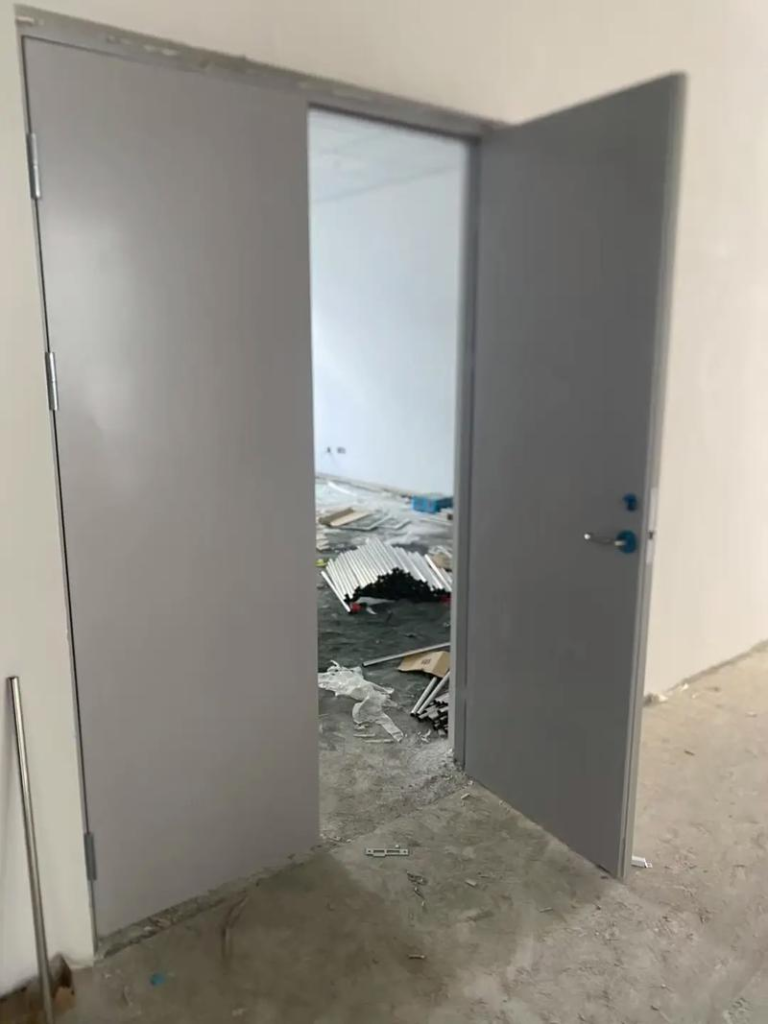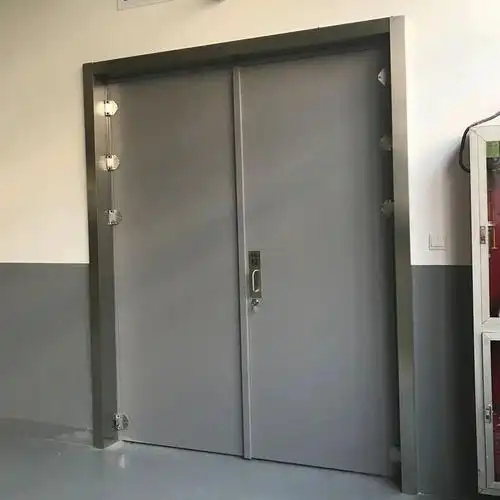
An intumescent fire seal (Intumescent Fire Seal) is a passive fire protection component installed in the rebate (groove) between the door leaf and frame of a fire-rated door. At ambient temperature it appears as a thin strip or rubber-like gasket; when exposed to heat, it undergoes a controlled chemical expansion to form a dense, thermally insulating char layer that seals the gap between the leaf and frame, preventing the penetration of flame, high-temperature smoke, and heat transfer, thereby maintaining the integrity (E) and insulation (I) of the fire compartment.
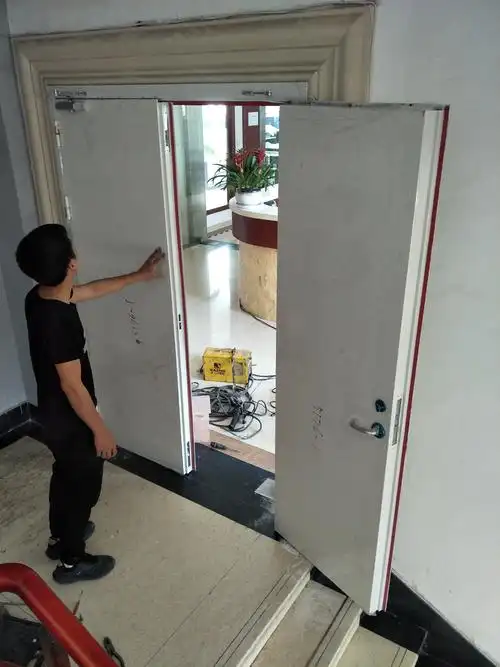
1. Is an Intumescent Seal Mandatory for Fire Doors?
Mandatory Requirements Under Major International Standards
| Standard System | Seal Configuration Requirement | Determination Logic |
|---|---|---|
| EN 1634-1 / EN 1363-1 | Mandatory; smoke-rated doors must additionally install smoke seals | The complete doorset must pass the fire resistance test; the seal is an inseparable component of the doorset |
| BS 476-20/22 | Mandatory; traditionally certified alongside FD30/FD60/FD90/FD120 ratings | Similar to EN 1634-1, the final judgment is based on the fire resistance duration of the complete doorset |
| UL 10C / NFPA 252 | Mandatory; under positive-pressure test conditions the seal is a critical component preventing upper-edge leakage | The complete doorset must pass positive-pressure fire resistance and Hose Stream tests |
| EOTA TR 024 / EAD 350005 | The intumescent material itself must pass fingerprint-parameter tests including expansion ratio and expansion pressure | Used for ETA (European Technical Assessment) and factory production control; does not by itself equate to doorset compliance |
Core Conclusion: Under international standard systems, fire doors must be equipped with intumescent seals; however, a seal cannot independently claim a fire rating separate from a specific doorset. It must undergo full-scale fire resistance testing together with that doorset.
Intumescent Seal vs. Smoke Seal
These two components serve different functions and are often confused:
- Intumescent Seal: Expands at high temperatures (100–200 °C), blocks fire and heat, does not prevent ambient-temperature smoke.
- Smoke Seal: Typically a brush or rubber strip that seals gaps at normal temperature, is not fire-resistant.
Fire and smoke doors (Fire and Smoke Door) must install both types simultaneously. For example, BS 9999 stipulates that if the under-door gap exceeds 3 mm, a smoke seal must be added.
2. Technical Data on Expansion Ratio
The Expansion Ratio refers to the ratio of the material’s thickness after thermal expansion to its original thickness. This value is not a pass/fail criterion for the door itself, but rather a characteristic parameter of the intumescent material, heavily influenced by the material system, test temperature, and test method.
Classification by Material System
| Material System | Expansion Ratio | Activation Temperature | Characteristics | Typical Application |
|---|---|---|---|---|
| Sodium Silicate Based | 5–10× | 100–160 °C | Low expansion temperature, fast foaming, good insulation; relatively weak moisture resistance | Wooden fire door rebate seals |
| Expandable Graphite Based | 3–10× (free expansion) 18–38× (specific formulation) | Approx. 200 °C | Higher expansion temperature, dense char layer, excellent durability | Steel fire doors, penetration seals, pipe wraps |
| Composite / Modified Formulation | 12–19×< 15–20× | Depends on formulation | Modified to balance expansion speed and pressure | High-end certified doorsets |
Data sources: Lorient/ASSA ABLOY technical data (sodium silicate 5–10×); Hengcheng product data (graphite 10×); ArmaProtect FC2 technical specs (graphite 18–38×); Hapuflam ETA-16/0748 (EOTA TR 024 tested 12–19×).
Why Do Different Sources Report Vastly Different Expansion Ratios?
- Different material systems: Sodium silicate and expandable graphite employ different chemical foaming mechanisms — the former generates silicate foam, the latter generates a graphite “worm-like” char layer. They are not directly comparable.
- Different test temperatures: EOTA TR 024 requires a pre-test to determine the optimal test temperature (typically 300–450 °C); higher temperatures yield more complete expansion, whereas at 200 °C graphite may only expand 3×.
- Different test methods:
- Method 1 (Free Expansion): No load; maximum expansion ratio, commonly used in product marketing.
- Method 2 (Restrained Expansion): Expansion in one direction within a mold with pressure measurement; expansion ratio is limited by mold height (e.g., a 4 mm sample in a 20 mm mold yields a maximum ratio of only 5:1), more closely approximating real gap-constraint conditions.
- Different application scenarios: Pipe wraps require high expansion pressure to clamp melted pipes; door-gap sealing requires rapid gap-filling but moderate pressure. The same material has different design targets in different scenarios.
3. Rationale and Differences Among Standard Systems
3.1 EN 1634-1 / EN 1363-1 System (Current European Mainstream)
Rationale: EN 1634-1 is a harmonized standard under the EU CPR (Construction Products Regulation) framework, designed to replace fragmented national door fire-test methods and achieve mutual recognition of CE marking. EN 1363-1 sets the general requirements for fire resistance tests, including furnace temperature curve, pressure conditions, and measurement methods.
Assessment logic for seals:
- Does not test expansion ratio in isolation. The seal, as one component of the doorset, must undergo full-scale prototype testing together with the specific door leaf, frame, hardware, and glazing.
- The judgment criteria are the doorset’s EI (Insulation + Integrity) or E (Integrity only) rating, plus Sa/S200 smoke classification (EN 1363-3).
- Once the doorset passes the test, the seal’s specifications (brand, dimensions, installation position) are locked in the certification report; any change requires re-testing or reassessment.
This means: even if a seal material boasts an expansion ratio as high as 50×, if it fails the EI60 test when paired with a particular doorset, that combination is still non-compliant.
3.2 BS 476-20/22 System (British Tradition, To Be Withdrawn by 2029)
Rationale: BS 476 was published in 1987 and has long been the UK’s fire resistance test standard, employing single-face fire exposure and neutral-pressure environments, focusing on material performance at the fire-exposed surface.
Key differences from EN 1634-1:
- Pressure environment: BS 476 is essentially neutral or slightly negative pressure, not simulating the positive-pressure thrust in real fires; EN 1634-1 has stricter pressure control, closer to actual fire conditions.
- Test scope: BS 476 leans toward material-level testing; EN 1634-1 mandates full-system testing, including integrated smoke control.
- Certification linkage: BS 476 cannot be used for CE or UKCA marking. The UK has announced full transition to EN 1634-1 by 2029, currently in a parallel transitional period.
Historical context: BS 476 was widely adopted across the Commonwealth and the Middle East, but following Brexit and the establishment of the UKCA marking system, EN 1634-1 has become the only recognized test pathway.
3.3 UL 10C / NFPA 252 System (North American Positive-Pressure)
Rationale: In the late 20th century, the U.S. identified a critical flaw in the older UL 10B (neutral-pressure test): real fires generate positive pressure inside buildings from expanding hot gases, but neutral-pressure testing failed to expose failure modes such as upper-edge leaf ejection and gap jetting. Around 1998, UL introduced UL 10C Standard for Positive Pressure Fire Tests of Door Assemblies, aligned with NFPA 252 and ASTM E152.
Core design of positive-pressure testing:
- A neutral-pressure plane is established at approximately 40 inches (≈ 1 m) above the door sill.
- Below the plane: Furnace pressure is lower than ambient, drawing in cool air (simulating makeup air).
- Above the plane: Furnace pressure exceeds ambient, actively pushing hot smoke outward against the upper edge, hinge side, and lock side of the door.
Profound impact on intumescent seals:
- Under positive pressure, flame and hot gases actively escape through door gaps; traditional sealing relying solely on leaf deformation contact becomes ineffective.
- This directly drove the mandatory proliferation of intumescent seals in the North American market — seals must expand rapidly under positive pressure and withstand outward thrust to maintain integrity.
- UL 10C doorsets must also pass the Hose Stream test (water-hose impact), verifying the structural stability of the expanded char layer under thermal shock and water impact.
3.4 EOTA TR 024 / EAD 350005 Material Assessment System
Rationale: The European Organisation for Technical Approvals (EOTA) recognized that intumescent material performance is strongly coupled to end-use scenarios — the same material may fail in a pipe wrap due to excessive expansion speed, yet fail in a door gap due to insufficient expansion speed. Therefore, a unified “expansion ratio → fire resistance duration” conversion formula cannot be established.
Technical logic:
- EAD 350005 Intumescent Fire Sealing and Stopping Products stipulates that intumescent materials must undergo technical description per EOTA TR 024.
- TR 024 defines Expansion Ratio, Expansion Pressure, Loss of Mass, and Infrared Fingerprint as “fingerprint parameters.”
- These parameters are not used to directly determine fire ratings, but rather for:
- Factory Production Control (FPC): Ensuring each batch matches the initial test sample.
- ETA Technical File: Establishing a material identity record for traceability.
- Selection Reference: Intumescent products without a specific end-use can be preliminarily screened based on expansion ratio and pressure.
In short: the EOTA system acknowledges that “material parameters ≠ system performance,” so fingerprint parameters control material consistency, while EN 1366/EN 1634 system tests control final performance.
4. Expansion Temperature and Activation Mechanism
| Material System | Activation Temperature | Expansion Behavior | Char Layer Characteristics |
|---|---|---|---|
| Sodium Silicate Based | 100–160 °C | Rapid foaming, expansion completes within minutes | Lightweight silicate foam, low thermal conductivity |
| Expandable Graphite Based | Approx. 200 °C | Relatively delayed, but char layer is dense | Graphite “worm-like” structure, high temperature resistant, resistant to airflow scour |
Key Engineering Implications:
- Sodium silicate-based seals begin expanding during the early stage of a fire (as smoke temperature first rises), sealing gaps before metal leaf deformation occurs, making them suitable for wooden doors and other doorsets with large deformation.
- Expandable graphite-based seals tolerate higher ambient temperatures (e.g., near pipes, equipment rooms), and their expanded char layer better withstands the positive-pressure airflow scour of UL 10C, making them suitable for steel doors and high wind-pressure scenarios.
5. Installation Specifications and Gap Requirements
The effectiveness of intumescent seals is highly dependent on installation precision. Excessive gaps cannot be filled after expansion; insufficient gaps prevent normal door operation.
| Application Scenario | Leaf-to-Frame Gap | Under-Door Gap | Applicable Standard |
|---|---|---|---|
| Fire-rated door only | 2–4 mm (sides and head) | ≤ 10 mm | BS 8214 / Manufacturer instructions |
| Fire and smoke door | ≤ 3 mm (sides and head) | ≤ 3–5 mm; if exceeded, under-door smoke seal must be added | BS 9999 / BS 8214 |
| UL 10C doorset | Locked per certification report, typically 3–4 mm | Locked per certification report | NFPA 80 |
Seals are typically supplied in dimensions of 15 mm × 4 mm or 20 mm × 4 mm, with self-adhesive backing, embedded into the rebate of the frame or leaf. Any on-site cutting, splicing, or replacement with a non-certified brand may invalidate the doorset’s certification.