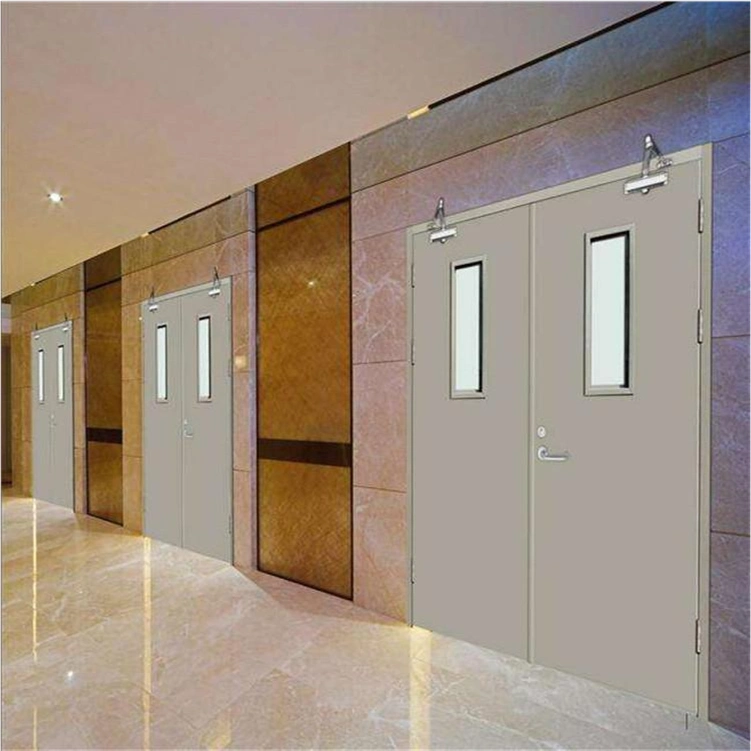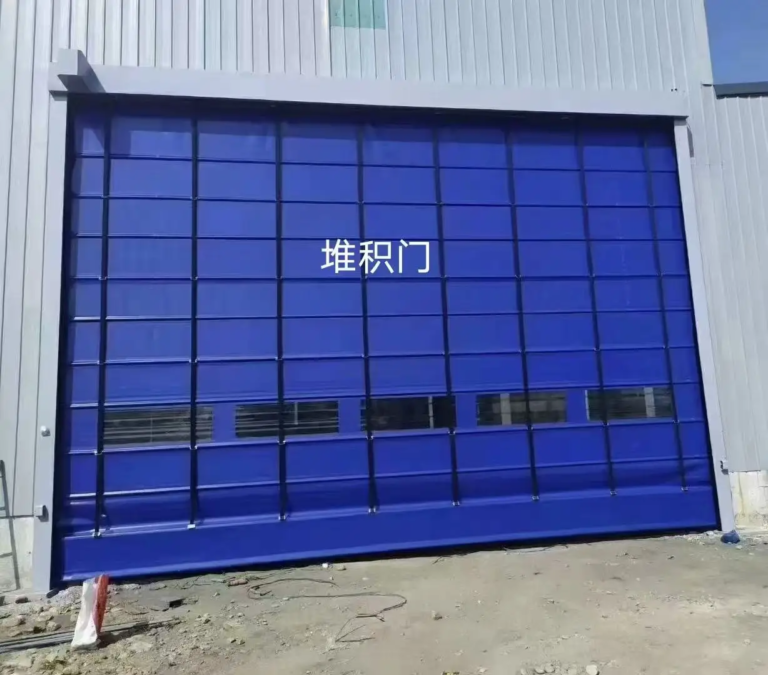
A steel fire door is a door assembly constructed with cold-rolled or galvanized steel sheets as face panels, internally filled with non-combustible thermal insulation material, capable of maintaining fire integrity and insulation for a specified duration. The steel plate thickness directly determines structural strength, resistance to deformation, and fire resistance performance. Different national/regional standard systems exhibit fundamental differences in how they regulate “steel plate thickness” — Chinese standards prescribe direct material minimums, while European and American standards are performance-test-oriented and do not mandate specific thickness values.
Table of Contents
- Steel Plate Thickness Requirements Under Each Standard System
- Rationale Analysis: Why Different Systems Regulate Differently
- Practical Engineering Configurations and Grade Correspondence
- Export Compliance Recommendations
- Related Standards Index
1. Steel Plate Thickness Requirements Under Each Standard System
1.1 Chinese Standard (GB 12955-2008)
GB 12955-2008 Fire Doors employs a “material + performance” dual regulation approach, directly specifying recommended steel plate thickness values in the standard text:
| Component | Steel Plate Thickness | Remarks |
|---|---|---|
| Door Frame | 1.2 – 1.5 mm | General openings ≥1.2 mm; openings with height >2.1 m or width >1.2 m should use ≥1.5 mm |
| Door Leaf Panel | 0.8 – 1.2 mm | Grade A doors commonly use 1.0–1.2 mm; Grade B/C commonly use 0.8–1.0 mm |
| Reinforcement Parts | 1.2 – 1.5 mm | If reinforcement parts have screw holes, steel thickness must be ≥ 3.0 mm |
| Hardware Accessories | — | Locks, hinges, bolts, etc. must have melting temperature ≥ 950 ℃ |
GB 12955-2008 uses the term “宜” (recommended), but domestic CCC certification and type inspection generally enforce the above ranges, making them de facto mandatory minimums.
1.2 European/British Standards (EN 1634-1 / BS 476-22)
EN 1634-1 and BS 476-22 are essentially fire resistance test method standards; the standard text does not directly specify steel plate thickness. It only requires that the doorset achieve the specified fire resistance rating under the standard temperature-rise curve. Steel thickness is determined by the manufacturer based on design and is locked in the certification report after passing full-scale prototype testing.
Based on European manufacturer and export product data, the market has formed conventional thickness configurations:
| Component | Common Steel Thickness | Source |
|---|---|---|
| Door Leaf Panel | 0.8 – 1.0 mm | Greek manufacturers use 0.8 mm for REI 60/120 doors; Chinese exports to EN markets mainstream at 1.0 mm |
| Door Frame | 1.5 – 1.6 mm | European mainstream configuration; some British standard doors use 1.6 mm (16 gauge) or 2.0 mm (14 gauge) |
The Scottish Building Standards Technical Handbook even includes a construction requirement of “steel at least 0.5 mm thick,” but this is a building code supplement for specific constructions, not a material minimum for fire doors under EN 1634-1 itself.
1.3 American Standards (UL 10C / NFPA 80 / NFPA 252)
The U.S. system likewise does not directly specify steel plate thickness. Compliance is confirmed through certification labels from third-party agencies such as UL (Underwriters Laboratories). Steel thickness is locked in the manufacturer’s UL certification file (Follow-Up Service Procedure), and engineering specifications are typically expressed in gauge.
| Fire Rating | Door Leaf Steel | Door Frame Steel | Remarks |
|---|---|---|---|
| 20/30/45 min | 18 gauge (≈ 1.0 mm) | 16 gauge (≈ 1.5 mm) | Corresponds to Chinese Grade B/C range |
| 60 min | 18 gauge (≈ 1.0 mm) | 16 gauge (≈ 1.5 mm) | Some manufacturers upgrade door leaf to 16 gauge |
| 90 min | 16 gauge (≈ 1.5 mm) | 14 gauge (≈ 1.9 mm) | Corresponds to Chinese Grade A range |
| 120 min | 14 gauge (≈ 1.9 mm) | 14 gauge (≈ 1.9 mm) | High-grade doors require overall thickening |
The American steel door industry standard ANSI/SDI A250.8 specifies gauge requirements for non-fire-rated steel doors, but fire-rated steel doors are governed by the specific design in the UL certification. Engineering tender documents commonly specify wording such as “Door Face Metal Thickness: 18 gauge, 0.042 inch (1.0 mm), minimum.”
2. Rationale Analysis: Why Different Systems Regulate Differently
2.1 Chinese GB System: “Material Floor” Thinking Driven by Administrative Supervision
GB 12955-2008 was born within China’s CCC (China Compulsory Certification) framework for fire protection products. Its logic is:
- Regulators need quantifiable handles: China is vast with manufacturers of varying capability. If only “fire resistance ratings” were prescribed, regulators would struggle to quickly determine product compliance during routine factory inspections. Directly specifying “door frame ≥1.2 mm, door leaf ≥0.8 mm” allows enforcement officers to perform on-site preliminary screening with a vernier caliper.
- Type inspection and production consistency: The CCC model requires “test sample = mass-produced product.” Material thickness is the hardest indicator for factories to secretly reduce later. Directly locking material specifications in the standard effectively locks the physical foundation of fire resistance performance.
- Planned economy legacy: Early Chinese building product standards commonly adopted “material + performance” dual regulation, emphasizing unified specifications for easier industry management.
Result: GB 12955-2008 is one of the few fire door standards globally that directly specifies steel plate thickness minimums in the standard text.
2.2 European EN/BS System: “Test-Locked” Thinking Oriented by Performance
The formulation logic of EN 1634-1 and BS 476-22 stems from Europe’s CPR (Construction Products Regulation) framework:
- Performance is the only hard indicator: European building codes only care whether “this door can survive 60 minutes in a fire,” not “how thick your steel is.” A manufacturer may use 0.8 mm steel + thick core board, or 1.5 mm steel + thin core board — as long as the full-scale prototype test is passed.
- Certification bodies lock the design: After passing the test, certification bodies (such as WHI, Certifire, BM TRADA, CSTB) issue a “Field of Application” document detailing steel thickness, core density, hardware model, etc. Any material change requires re-assessment or re-testing.
- Market self-regulation: Because the European market heavily relies on third-party certification and insurance systems, manufacturers will not blindly reduce steel thickness — although thinning reduces cost, the consequences of test failure or certification revocation far exceed any material savings.
Result: The EN/BS standard text “contains no steel plate thickness,” yet the market has formed a conventional configuration of 0.8–1.0 mm door leaf + 1.5 mm door frame through the certification system.
2.3 American UL/NFPA System: “Label System” Thinking Driven by Insurance and Liability
The evolution of American fire door standards is deeply intertwined with the fire insurance industry:
- UL was born to serve insurance claims: In the late 19th century, frequent fires in the U.S. created demand for a quantifiable risk assessment system, and UL emerged accordingly. A fire door is not merely “meeting the standard” — it must bear a UL label proving that the door has been tested at a UL laboratory per NFPA 252 or UL 10C.
- The label is the law: NFPA 80 Standard for Fire Doors and Other Opening Protectives stipulates that fire doors must maintain their label intact, which identifies the manufacturer, fire rating, and test standard. A fire door without a label is legally deemed non-compliant.
- Historical inertia of the gauge system: American steel has long been traded in gauge units: 18 gauge = 0.0478 inch (approx. 1.21 mm), 16 gauge = 0.0598 inch (approx. 1.52 mm). This imperial unit system persists today, creating conversion headaches when aligning technical documents between China, the U.S., and Europe.
Result: American standards do not prescribe “minimum thickness,” but the UL certification files and NFPA 80 label system form a de facto thickness threshold — 18 gauge / 16 gauge have become market mainstream.
3. Practical Engineering Configurations and Grade Correspondence
| Fire Rating | Common Chinese GB Configuration | Common European EN/BS Configuration | Common American UL Configuration |
|---|---|---|---|
| 30 min (Grade C) | Frame 1.2 mm / Leaf 0.8 mm | Frame 1.5 mm / Leaf 0.8 mm | Frame 16 gauge / Leaf 18 gauge |
| 60 min (Grade B) | Frame 1.2 mm / Leaf 1.0 mm | Frame 1.5 mm / Leaf 1.0 mm | Frame 16 gauge / Leaf 18 gauge |
| 90 min (Grade A) | Frame 1.5 mm / Leaf 1.2 mm | Frame 1.5–1.6 mm / Leaf 1.0 mm | Frame 14 gauge / Leaf 16 gauge |
| 120 min | Non-standard, requires special design | Frame 1.6–2.0 mm / Leaf 1.2 mm | Frame 14 gauge / Leaf 14 gauge |
Note: European 120-minute steel doors typically require overall door leaf thickening to 60 mm or more, with high-density mineral wool core board (≥ 100 kg/m³).