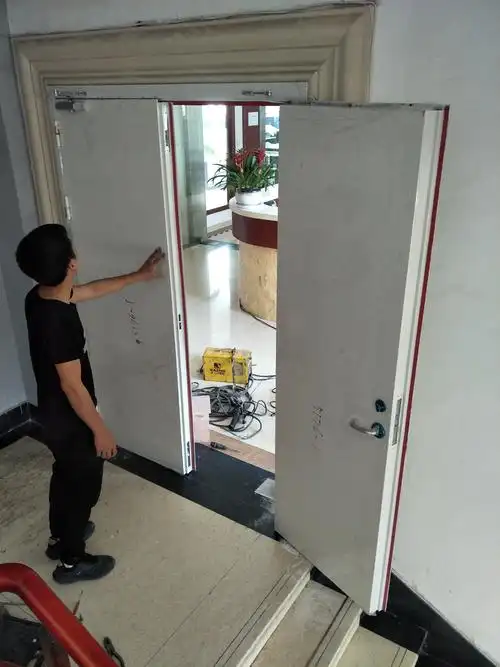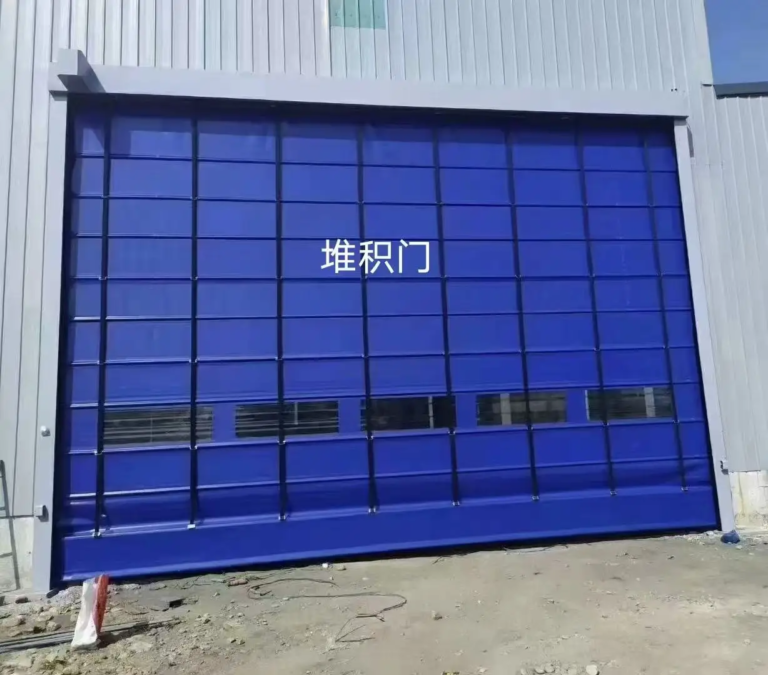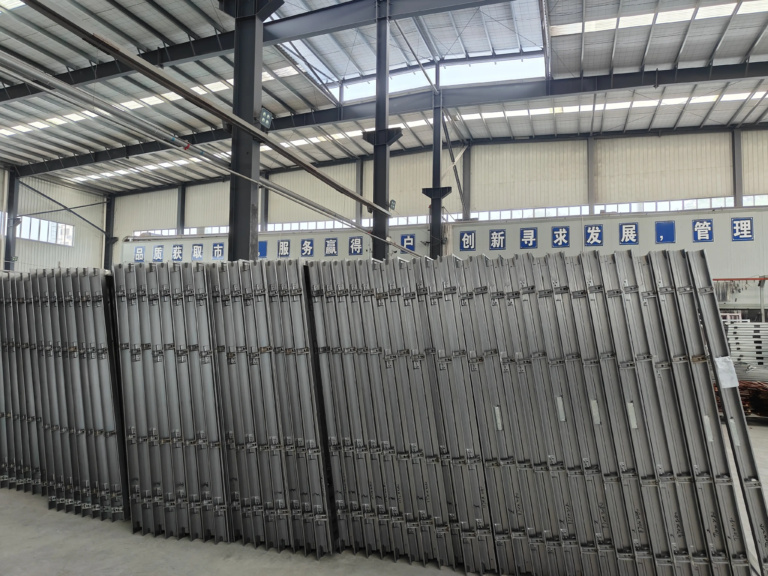
The 2024 edition of the standard (GB 12955-2024) retains the popular Grade A/B/C classification while introducing an internationally aligned Class A (insulation), Class B (partial insulation), and Class C (non-insulation) classification system, covering the complete fire resistance rating range from 0.5 hours to 3.0 hours.
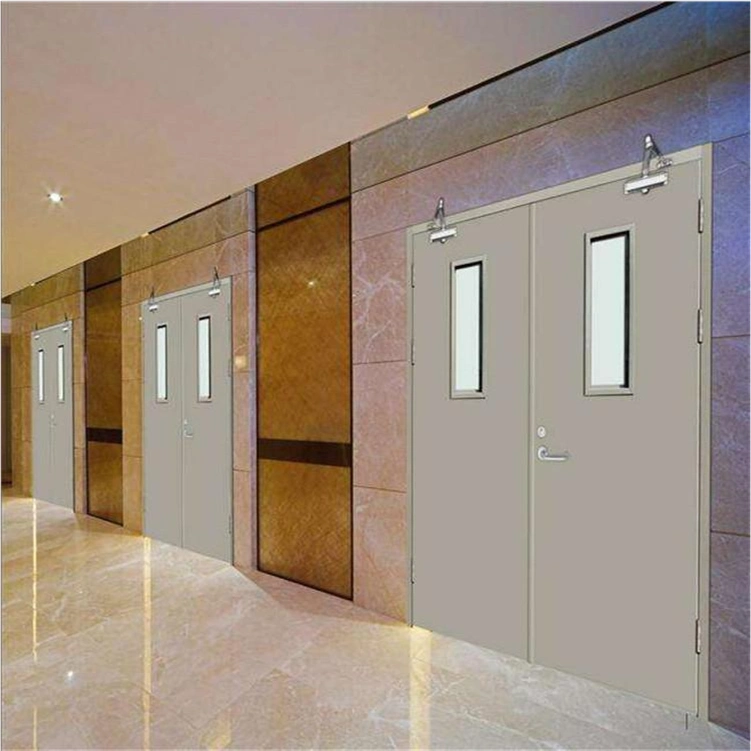
I. Detailed Grading System
1. Grade A Fire Door
| Item | Technical Parameter |
|---|---|
| Fire Resistance Rating | ≥1.50 hours (90 minutes) |
| Door Frame Steel Plate | ≥1.2 mm (standard) / ≥1.5 mm (when fire resistance rating > 1.5h) |
| Door Leaf Panel | ≥0.8 mm (minimum) / ≥1.0 mm recommended |
| Total Door Leaf Thickness | ≥45 mm (minimum), typically 50–55 mm |
| Insulation Requirement | Must maintain unexposed face temperature rise ≤140°C (average) / ≤180°C (single point) throughout |
Definition: Grade A fire doors represent the highest conventional fire resistance requirement in civil buildings. They are primarily used at firewall openings, important equipment rooms, and smoke-proof stairwells—critical fire separation locations.
2. Grade B Fire Door
| Item | Technical Parameter |
|---|---|
| Fire Resistance Rating | ≥1.00 hour (60 minutes) |
| Door Frame Steel Plate | ≥1.2 mm |
| Door Leaf Panel | ≥0.8 mm |
| Total Door Leaf Thickness | ≥45 mm |
| Insulation Requirement | Must maintain unexposed face temperature rise limits throughout |
Definition: Grade B fire doors are the most commonly used grade in evacuation corridors, balancing fire resistance performance with cost-effectiveness. They are widely applied in evacuation corridors, anterooms, and enclosed stairwells.
3. Grade C Fire Door
| Item | Technical Parameter |
|---|---|
| Fire Resistance Rating | ≥0.50 hour (30 minutes) |
| Door Frame Steel Plate | ≥1.2 mm |
| Door Leaf Panel | ≥0.8 mm (minimum), commonly 0.6–0.8 mm in the market |
| Total Door Leaf Thickness | ≥40 mm |
| Insulation Requirement | Must maintain unexposed face temperature rise limits throughout |
Definition: Grade C fire doors have the lowest conventional fire resistance requirements. They are mainly used for vertical pipe shafts, cable shafts, and other secondary fire separation locations, only required to maintain fire integrity for a certain period to prevent rapid vertical fire spread through shafts.
II. Horizontal Comparison of Core Parameters Across Three Grades
| Comparison Dimension | Grade A | Grade B | Grade C |
|---|---|---|---|
| Fire Resistance Rating | ≥1.50h | ≥1.00h | ≥0.50h |
| Designation (GB 12955-2008) | Grade A | Grade B | Grade C |
| Designation (GB 12955-2024) | A1.50 | A1.00 | A0.50 |
| Door Frame Thickness Minimum | ≥1.2 mm (standard) ≥1.5 mm (high spec) | ≥1.2 mm | ≥1.2 mm |
| Panel Thickness Minimum | ≥0.8 mm | ≥0.8 mm | ≥0.8 mm |
| Total Door Leaf Thickness Minimum | ≥45 mm | ≥45 mm | ≥40 mm |
| Hinge Plate Minimum | ≥3.0 mm | ≥3.0 mm | ≥3.0 mm |
| Reinforcement with Screw Holes | ≥3.0 mm | ≥3.0 mm | ≥3.0 mm |
| Hose Stream Test | Required (new in 2024 edition) | Required (new in 2024 edition) | As required |
| Smoke Leakage Resistance | Mandatory | Mandatory | As required |
| Typical Price Range | Mid-to-high | Medium | Lower |
III. Application Scenarios and Selection Guide
3.1 Selection by Building Location
| Building Location | Recommended Grade | Selection Basis |
|---|---|---|
| Firewall Opening | Grade A | Firewall fire resistance rating typically ≥3.0h; doors as weak links need ≥1.5h |
| Smoke-proof Stairwell | Grade A | Core personnel evacuation channel requiring highest level protection |
| Fire Elevator Anteroom | Grade A / Grade B | Grade A mandatory for high-rise; Grade B acceptable for multi-story |
| Electrical Room, Equipment Room | Grade A | High fire load requiring extended fire resistance time |
| Evacuation Corridor | Grade B | Sufficient for personnel evacuation time; economically reasonable |
| Enclosed Stairwell | Grade B | Mandatory per code requirements |
| Pipe Shaft, Cable Shaft | Grade C | Only needs to prevent vertical fire spread; no human occupancy |
| Boiler Room, Gas Meter Room | Grade A or A2.0+ | Special high-risk locations often requiring 2.0h+ fire resistance rating |
3.2 Selection by Building Type
| Building Type | Typical Configuration |
|---|---|
| High-rise Residential (>54m) | Smoke-proof stairwell Grade A, anteroom Grade B, pipe shaft Grade C |
| Hospital, Nursing Home | Evacuation corridors Grade B or above, equipment rooms Grade A |
| Underground Commercial (>2 floors or >10,000㎡) | Primarily Grade A, some evacuation corridors Grade B |
| Data Center | Grade A + EIS (smoke control), some areas requiring 2.0h+ |
| Industrial Plant (Class C Warehouse) | Determined by fire compartment area, typically Grade B minimum |
IV. Core Selection Principles
Principle 1: Door-Wall Matching
The fire resistance rating of a fire door shall not be lower than the fire resistance requirement of the wall where it is installed. According to general building code logic, the fire door grade is typically 50%–75% of the wall’s fire resistance rating. For example, a 2.0h firewall requires at least a Grade A (1.5h) door.
Principle 2: Personnel Priority
Areas with personnel traffic or occupancy must use insulation-type (Class A) fire doors to ensure unexposed face temperature rise will not burn evacuating personnel. Unoccupied pipe shafts may use doors with integrity-only requirements.
Principle 3: Smoke Priority Over Flames
In high-rise buildings, smoke fatality rates far exceed those from open flames. When selecting, do not look only at fire resistance duration; a Grade B door with smoke control (S marking) is often safer than a Grade A door without smoke control.
Principle 4: Do Not Blindly Pursue Higher Grades
Grade A doors cost 30%–50% more than Grade B. Using Grade A in non-required locations constitutes over-configuration. Grade C doors should not be arbitrarily upgraded to Grade B when code requirements are already met.
V. Common Selection Misconceptions
| Misconception | Correct Understanding |
|---|---|
| “Grade A is always better than Grade B” | Selection depends on matching, not grade superiority. Using Grade A for pipe shafts is wasteful; using Grade C for evacuation corridors is non-compliant. |
| “Longer fire resistance means safer” | For personnel evacuation, evacuation must be completed within 30 minutes. Fire resistance ratings beyond evacuation time have limited significance for personnel safety and primarily protect building structure. |
| “Thicker steel plate equals higher grade” | Grade is determined by fire resistance rating, not steel plate thickness. Grade A door panel minimum is also 0.8 mm; the difference lies in the infill layer and overall structure. |
| “All fire doors must be insulated” | The 2024 edition permits Class C (non-insulation) doors for specific locations. Equipment rooms and pipe shafts may use non-insulation types when code allows. |
| “Non-standard doors can be made arbitrarily” | Oversized fire doors (e.g., above 2.4m × 2.4m) must have corresponding type inspection reports; otherwise they cannot pass acceptance. |
VI. Key Changes in the 2024 Edition Standard
GB 12955-2024 impacts selection logic as follows:
| Change Item | Impact on Selection |
|---|---|
| A/B/C Classification System | In addition to Grade A/B/C, design documents may directly specify “A1.50,” “C1.00,” etc.; procurement must verify accordingly |
| Mandatory Smoke Leakage Resistance | Grade B and above doors must be tested for smoke leakage resistance; confirm “S” marking when selecting |
| Hose Stream Test | Doors with fire resistance ≥60 minutes must pass hose stream testing, imposing higher structural requirements |
| Graded Door Frame Thickening | Door frame minimum for >1.5h doors increased from 1.2 mm to 1.5 mm; procurement must specify fire resistance rating |
| Hardware Fire Resistance Coordination | Door closers, sequence controllers, and other hardware must match the door grade and cannot be downgraded independently |
VII. Quick Selection Reference Table
| Scenario | Recommended Grade | Key Reminder |
|---|---|---|
| Firewall, fire separation wall opening | Grade A | Must be insulation type (Class A) |
| Smoke-proof stairwell and anteroom | Grade A / Grade B | Grade A mandatory for high-rise |
| Fire control room, equipment room | Grade A | Pay attention to coordination between ventilation louvers and door |
| Evacuation corridor | Grade B | Prioritize selection with smoke control |
| Pipe shaft, cable shaft access door | Grade C | Vertical shafts must be sealed at every floor |
| Boiler room, gas meter room | Grade A or A2.0+ | Special high-risk location requiring specialized design |
| Underground garage evacuation corridor | Grade B | Pay attention to moisture-proof treatment |
Conclusion
The selection among Grade A, B, and C is essentially “exchanging standardized time for standardized survival space.” Understanding the grading system is not about memorizing the numbers 90 minutes, 60 minutes, and 30 minutes, but about establishing the engineering mindset of “door-wall matching, personnel priority, and smoke control.”
For purchasers, simply remember three minimum numbers: frame 1.2, panel 0.8, screw-hole reinforcement 3.0. If any value falls below these thresholds, regardless of the claimed grade, the product should be rejected outright.